Technology, architecture & business — written by the Brightnous team
Zepto Architecture
Contents
Introduction
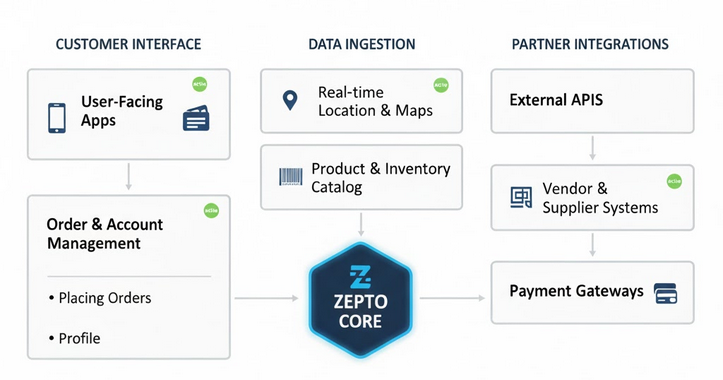
Zepto successfully built a system designed to deliver products in a mere 10 minutes, a goal that demands speed, zero errors, and scalability, even under heavy load. The system's architecture revolves around four main layers: Frontend, Backend, Data Layer, and Integration Layer, all communicating via APIs for modularity and speed.
Key Architectural Learnings and Our Applications
1. Achieving Instant Search Speed
For the search system, Zepto uses Elasticsearch for instant text and location-filtered search. They minimize database hits by utilizing a Redis cache to store frequently searched products. All requests are routed through an API Gateway.
Our Actionable Steps:
> Integrate Spring Data Elasticsearch into our search modules.
> Use Redis for caching frequently accessed data to avoid directly querying
MySQL for every search request.
2. Ensuring Data Accuracy and Consistency
Dealing with multiple modules (like inventory and delivery) updating the same data creates a risk of mismatches (e.g., an item shows as available when it's sold). Zepto solved this by adopting an Event-driven architecture using Kafka. Every data update triggers an event, which in turn updates data across all relevant services, maintaining consistency.
Our Actionable Steps:
> Utilize Spring Kafka or RabbitMQ for asynchronous data updates.
> Avoid direct joins between unrelated modules to increase decoupling and
maintain separate, accurate data sets.
3.Scaling for Heavy Load
To handle a large user base and heavy traffic, the Zepto development team implemented several core scalability solutions:
Microservices: Breaking the system down so that modules like Orders, Inventory, and Delivery run independently.
Containerization: Using Docker and Kubernetes for automatic scaling, load balancing, and auto-restart on failure
Load Balancers (Nginx): Distributing traffic efficiently.
Our Actionable Steps:
> Move toward a modular architecture by splitting our existing monolith
into smaller, independent services.
> Adopt containerization with Docker to streamline deployment and
scaling.
> Implement basic load balancing with Nginx.
4.Real-Time Delivery and Tracking
A 10-minute delivery promise requires real-time communication. Zepto achieves this with real-time GPS tracking using the Google Maps API and by employing WebSockets or MQTT to send instant updates to users.
Notifications are pushed via Firebase.
Our Actionable Steps:
> Use Spring WebSocket to add real-time features like live order status
updates or in-app chat.
> Incorporate message queues for asynchronous, real-time updates to
enhance user engagement.
Conclusion
Zepto’s success is a testament to smart system design, modularity, and automation. Their core goal—delivering fast with zero errors—was met through leveraging technologies like Elasticsearch, Kafka (Event-driven architecture), and Microservices/Kubernetes. By adopting these lessons—from utilizing caching and decoupling modules to embracing containerization and real-time messaging—we can significantly boost the performance and scalability of our own applications.