Technology, architecture & business — written by the Brightnous team
LinkedIn Architecture
Contents
- 2003–2007: The Monolithic Era
- 2008–2012: Transition to Service-Oriented Architecture (SOA)
- 2013–2017: Microservices & Real-Time Data
- 2018–2021: Cloud-Native & AI at Scale
- 2022–2025: The Intelligent, Global Platform
- Part 1: The Monolithic Beginning (2003–2007)
- ? Part 2: Breaking into Microservices (2008–2012)
- ?️ Part 3: The Data Revolution (2013–2017)
- ? Part 4: Infrastructure & Deployment (2018–2025)
- ? Part 5: AI & Personalization (2017–2025)
- ? Part 6: Global Scale in 2025
- ? Key Lessons for Engineers
- ? Why This Matters for Beginners
- ? What’s Next? (Beyond 2025)
"How LinkedIn Works: A Beginner's Guide to Billion-User Architecture"
Introduction: More Than Just a Social Network
LinkedIn isn’t just where professionals connect—it’s one of the world’s most sophisticated engineering platforms. Serving 1 billion+ members across 200+ countries, LinkedIn’s architecture is a masterclass in scaling, resilience, and intelligence. From its humble beginnings as a single Java application to today’s distributed, event-driven micro services ecosystem, LinkedIn’s evolution reflects the broader story of modern software engineering. In this deep dive, we’ll explore not just what they built, but how and why—making complex concepts accessible for developers at any level.
? History & Timeline: LinkedIn’s Engineering Evolution (2003–2025)
2003–2007: The Monolithic Era
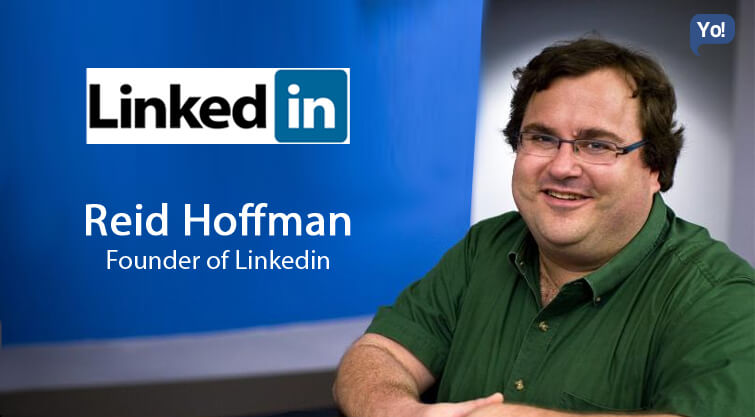
- 2003: LinkedIn founded by Reid Hoffman and team. Built as a single Java monolith using JSP, Struts, and a MySQL database.
- 2004–2006: Early growth—networking, profiles, and job postings. All features bundled into one deployable unit.
- 2007: IPO preparation and user growth exposed scaling bottlenecks. Database contention, slow deployments, and tight coupling became critical issues.
2008–2012: Transition to Service-Oriented Architecture (SOA)
- 2008–2009: Began decomposing the monolith into functional services (Profiles, Connections, Jobs).
- 2010: Introduced REST APIs for inter-service communication. Early adoption of Apache Kafka (originally built at LinkedIn) for asynchronous messaging.
- 2011: Launched LinkedIn Today (news feed), requiring real-time updates—accelerated move toward event-driven design.
- 2012: Open-sourced Kafka and Apache Samza. Fully embraced distributed systems mindset.
2013–2017: Microservices & Real-Time Data
- 2013–2015: Fully migrated to microservices. Each team owned a service end-to-end.
- 2015: Launched Economic Graph—a digital map of jobs, skills, people, and companies.
- 2016: Microsoft acquires LinkedIn. Began hybrid cloud integration while maintaining on-prem infrastructure.
- 2017: AI-powered Feed ranking launched. Real-time personalization became core to UX.
2018–2021: Cloud-Native & AI at Scale
- 2018: Adopted Docker and Kubernetes for container orchestration.
- 2019: Rolled out GraphQL for efficient frontend-backend communication.
- 2020: Pandemic-driven traffic spikes handled via auto-scaling microservices. Zoomed past 700 million members.
- 2021: Deep investment in real-time ML with TensorFlow and PyTorch. Launched Skills Assessments and Creator Mode.
2022–2025: The Intelligent, Global Platform
2025: Real-time graph neural networks (GNNs) power hyper-personalized job matches and network suggestions.
2022: Surpassed 900 million members. Fully integrated Microsoft Azure for hybrid cloud resilience.
2023: Generative AI features launched (e.g., AI-assisted profile writing, smart replies).
2024: 1 billion members milestone. Edge computing rollout for low-latency global access.
Part 1: The Monolithic Beginning (2003–2007)
Imagine a single, giant application where every feature—profiles, jobs, messages—was packed into one codebase. That was LinkedIn’s early architecture.
Tech Stack:
- Java + JSP + Struts (frontend and backend combined)
- Single MySQL database
- One deployment package
How It Worked:
When you updated your profile, the whole app rebuilt. If the Jobs feature had a bug, the entire platform could go down.
Why It Failed at Scale:
- Database bottlenecks: One database for 10+ features meant constant locking and slowdowns.
- Deployment nightmares: Updating the messaging system required taking down job searches.
- No team autonomy: Developers waited in line to merge code into the monolith.
Example:
In 2006, launching “Who’s Viewed Your Profile” caused a 30% slowdown across LinkedIn because it shared the same database and server as everything else.
? Part 2: Breaking into Microservices (2008–2012)
LinkedIn moved from a “big ball of mud” to an apartment building of services, each independent and scalable.
Key Technologies Introduced:
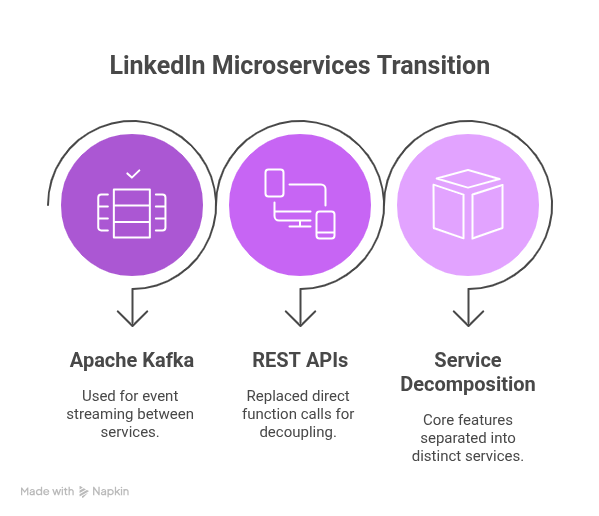
- Apache Kafka: Created at LinkedIn to handle event streaming between services.
- REST APIs: Replaced direct function calls between modules.
- Service decomposition: Profiles, Connections, Feed, Messaging became separate services.
How It Worked with Kafka:
When you sent a connection request:
- Connection-service wrote an event to Kafka:
"userA connected to userB" - Notification-service listened and sent an email
- Feed-service updated both users’ networks
Benefits:
- Teams could deploy independently
- Failures were isolated (if Messages went down, Jobs still worked)
- Scalability per service, not per entire app
?️ Part 3: The Data Revolution (2013–2017)
With microservices came the need for distributed, scalable data storage.
What They Built/Used:
- Espresso: LinkedIn’s distributed document store for user profiles.
- Venice: Derived data store for pre-computed feeds and recommendations.
- Apache Hadoop & Spark: Batch processing for analytics and ML training.
- Kafka Streams & Samza: Real-time stream processing.
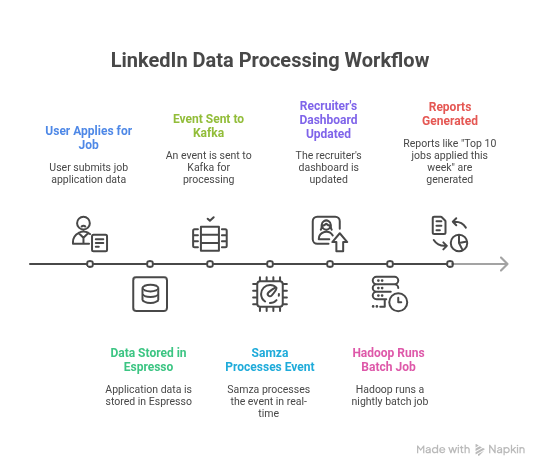
Example Data Flow:
You apply for a job:
- Application stored in Espresso
- Event sent to Kafka
- Samza processes in real-time: updates recruiter dashboard
- Hadoop runs nightly batch job: “Top 10 jobs applied this week”
? Part 4: Infrastructure & Deployment (2018–2025)
To manage thousands of microservices, LinkedIn adopted cloud-native tooling.
Tech Stack:
- Docker: Containerized each microservice.
- Kubernetes: Orchestrated containers globally.
- Azure Cloud: Hybrid cloud for burst capacity and redundancy.
- Canary Deployments: Roll out features to 1% of users first.
Real-World Example:
During the 2020 pandemic, LinkedIn traffic spiked 50% in 48 hours. Kubernetes automatically spun up 3,000+ new containers across Azure and on-prem data centers to handle load—zero downtime.
? Part 5: AI & Personalization (2017–2025)
LinkedIn’s AI transforms raw data into personalized experiences.
How It Works:
- Feed Ranking: Uses TensorFlow models trained on your clicks, likes, and time spent.
- Job Recommendations: Graph Neural Networks (GNNs) traverse the Economic Graph to find perfect matches.
- Real-Time Inference: Models updated hourly with fresh Kafka data.
Example in Action:
You view 3 machine learning jobs:
- Kafka streams your actions to the ML pipeline
- GNN finds similar users who viewed ML jobs → then got hired
- Within 100ms, your feed shows “ML jobs you may like” and “People in ML you should connect with”
? Part 6: Global Scale in 2025
By the Numbers:
- 1B+ members in 200+ countries
- 100,000+ microservice instances
- 7 trillion daily events through Kafka
- Real-time AI inferences under 100ms
- Hybrid cloud: 60% on-prem, 40% Azure
? Key Lessons for Engineers
- Start Monolithic, But Plan to Split: LinkedIn didn’t start with microservices—they evolved.
- Events Over HTTP: Kafka enabled resilience and scalability that REST alone couldn’t.
- Own Your Data Per Service: No shared databases—each service controls its data.
- Infrastructure as Code: Docker and Kubernetes turned deployment from art to science.
- AI Needs Real-Time Data: Personalization requires fresh events, not yesterday’s batch data.
? Why This Matters for Beginners
Understanding LinkedIn’s journey helps you:
- Learn industry-standard tools (Kafka, Docker, K8s, TensorFlow)
- See micro services in action—not just theory
- Appreciate the importance of data flow and events
- Prepare for system design interviews with real-world examples
? What’s Next? (Beyond 2025)
- AI-First Architecture: Every feature powered by real-time machine learning.
- Edge Computing: Faster experiences via localized micro services.
- Quantum-Safe Security: Preparing for post-quantum cryptography.
- Decentralized Identity: Using blockchain for verifiable credentials.
LinkedIn’s story isn’t just about technology—it’s about adaptability. They built, borrowed, and invented tools to solve problems at scale. And that’s the heart of engineering: solving real problems for real people, one line of code—or one event stream—at a time.